Project Silva Green Pathways

The Project Silva Green Pathways targets two afforested areas located in Mellieħa, namely L-Aħrax ta’ Ġewwa and an area at il-Miżieb. In total, these sites cover an area over 5.5 hectares in the Northern part of Malta. Afforestation efforts in the 1970s transformed these sites into woodlands primarily dominated by Aleppo Pines (Pinus halepensis). L-Aħrax ta’ Ġewwa is a site of national importance and scheduled as an Area of High Landscape Value (AHLV) and an Area of Ecological Importance (G.N. 400 of 1996). These sites are found in the vicinity of three Natura 2000 sites; including L-Inħawi tar-Ramla tat-Torri u tal-Irdum tal-Madonna, is-Simar and il-Wied tal-Miżieb. Both l-Aħrax ta’ Ġewwa (2020) and il-Miżieb (2019) sites have suffered from recent man-made fire disasters leading to the destruction of important habitats and of thousands of mature trees including Aleppo pines. These fires significantly led to the exacerbation of the invasion of non-native Acacia spp

Silva - FB 5

​ The objectives of the project are to:

  • Create ecological buffers and corridors connecting various Natura 2000 sites;
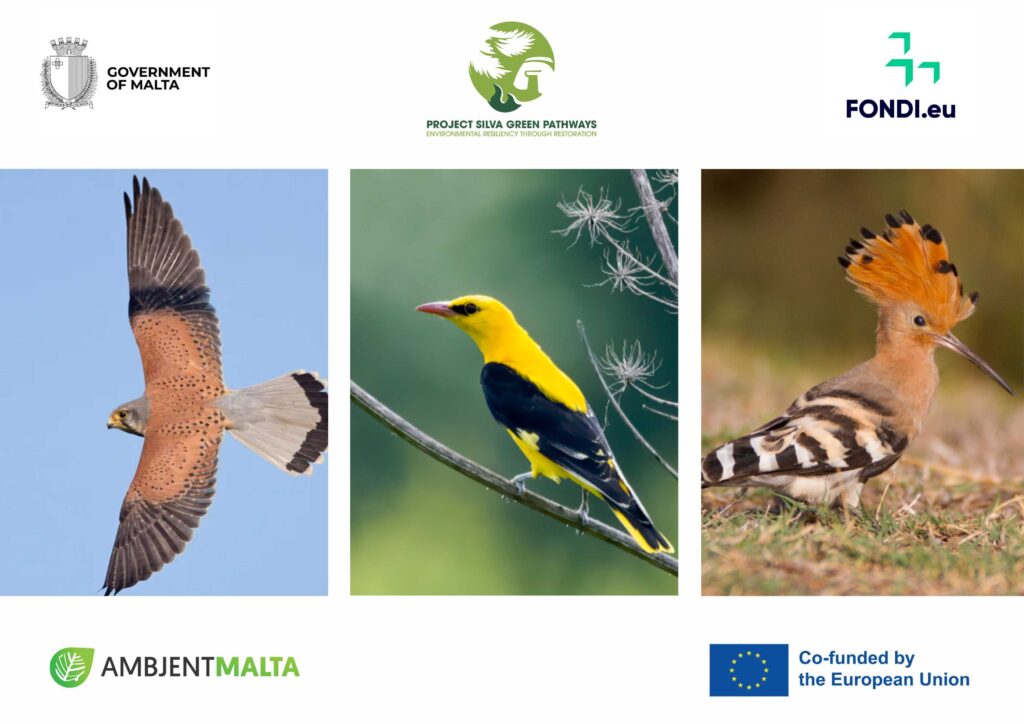
  • increase the sites’ potential as a refuge for migrating species through increased and diversified tree cover and food sources;
  • limit and control the invasion of invasive and non-native plants that diminish and exert pressure on native biodiversity;
  • reduce wildfire risks by the reduction in the fuel load through the removal of dead trees and installation of information and fire rescue alert signs;
  • improve the soil characteristics of the area, namely by increasing soil-water retention and soil-organic content through the dispersion of surface mulching;
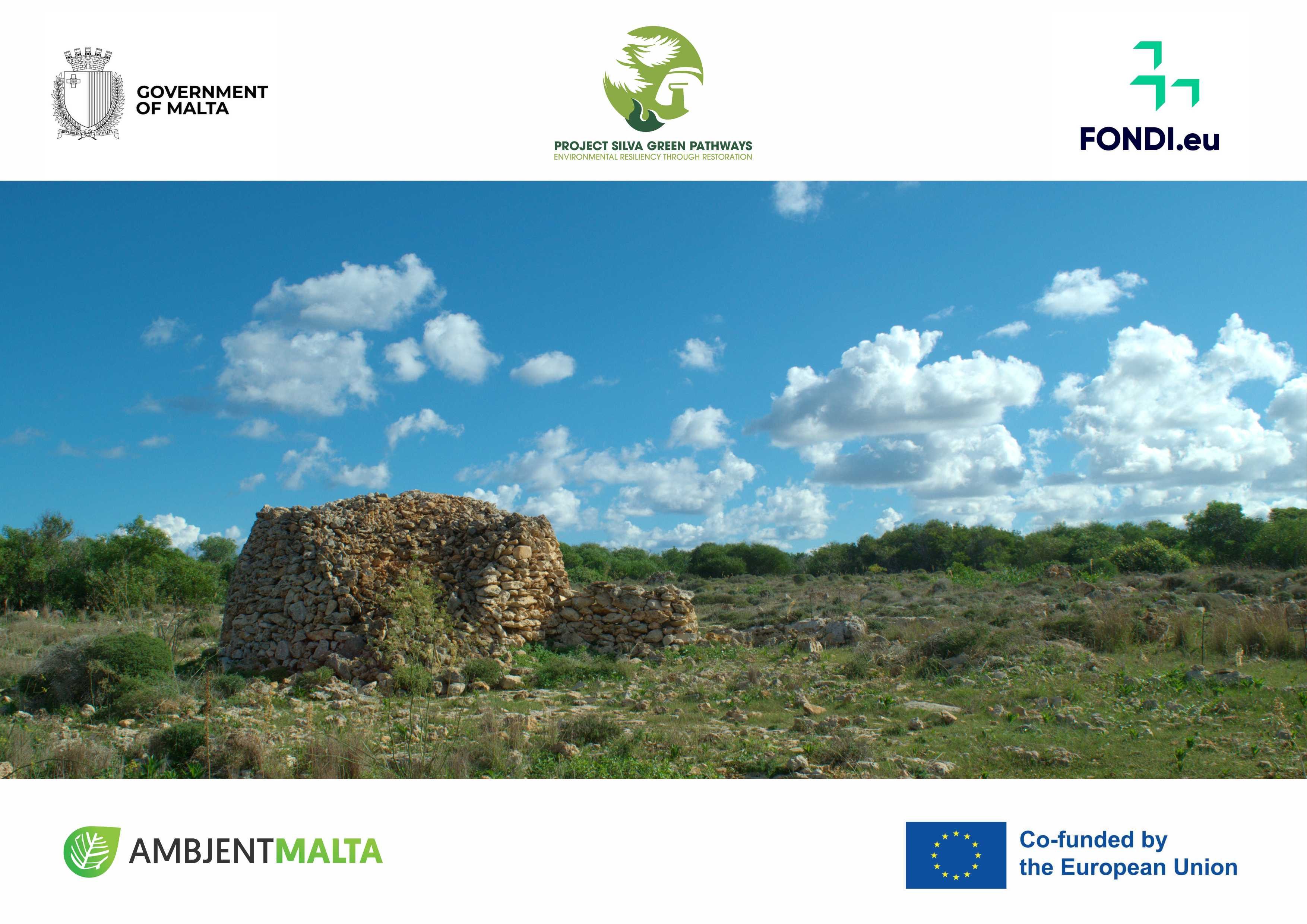
  • enhance the site’s visual landscape characteristics through the restoration of a dilapidated vernacular structure;
  • enhancement of the area’s carbon sequestration potential through the increase of tree cover from the current 8.5% to 42% of a 5.5 ha area. Thus, contributing to Malta’s national climate change mitigation measures.
  • create green open spaces for public enjoyment.

These objectives will be achieved through the implementation of following actions:

  1. Shredding down of dead pine trees and use material on-site as mulch to improve soil-water retention and enhance organic soil matter
  2. Implementation of measures to control the expansion of invasive and non-native Acacia spp. trees
  3. Installation of water efficient irrigation systems connected with existing New Water infrastructure
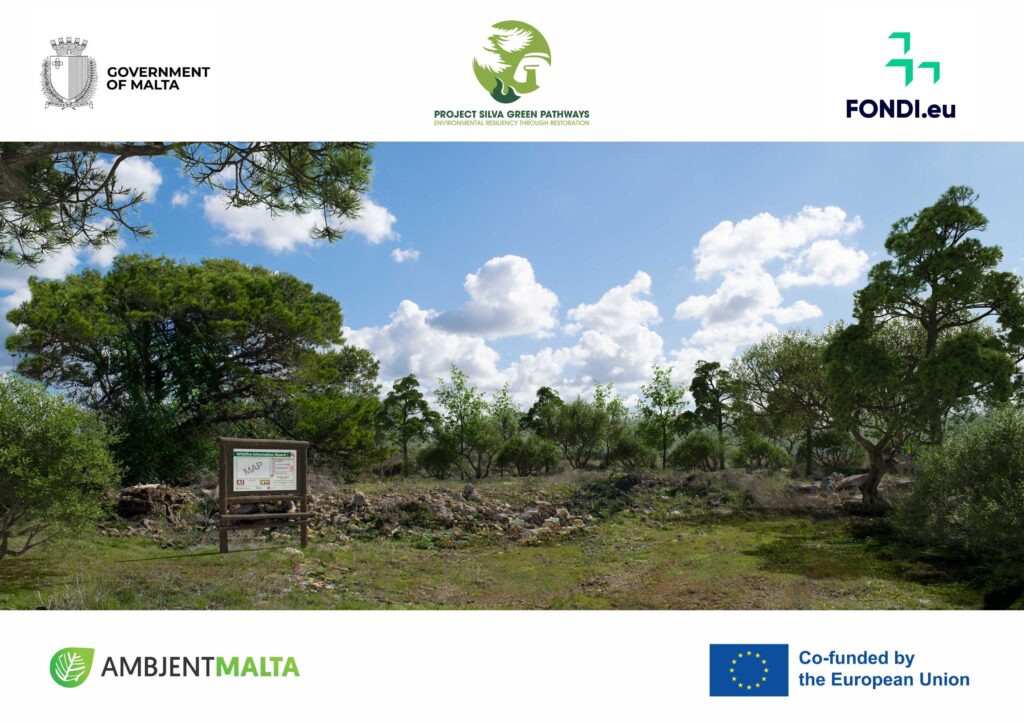
  4. Planting of 1,897 trees and shrubs. Planting will be carried out in mixed clusters, with spaces between them to serve as fire breaks. Selected species of trees and shrubs chosen for interplanting with the existing trees (mostly Pinus halepensis) are Quercus ilex, Quercus coccifera, Phillyrea latifolia, Rhamnus alaternus, Ceratonia siliqua and Pistacia lentiscus. These are all woodland species that are typically found growing together in olive and carob woodland habitats. In addition, most of the chosen species respond well to fire, where they are tolerant of intense heat and/or have low flammability rates
  5. Deployment of seed bombs in a garrigue area to enhance plant diversity. Seed bombs protect the seeds from desiccation and predation from wildlife, especially rodents, giving them a higher chance of survival in an arid environment. They also aid in seed germination, as the nutrients inside the seed bombs nourish the germinating plant. Another advantage of seeding via seed bombs is that seeds of plants that are compatible with one another (companion planting), can be used inside the seed balls and seeded together. The species proposed for seeding of the garrigue areas include Hypericum aegypticum, Cistus creticus, Cistus monspeliensis, Erica multiflora, Euphorbia dendroides. These are plant species that are typical of lower garrigue areas, are drought and wind tolerant and usually display difficulty in transplanting, when grown in pots. These seeds will be collected locally to ensure that no foreign genetic material or diseases are introduced. Seeds bombs and seeding will be carried out with the collaboration of ESA – Earth Systems Association, University of Malta.
  6. Restoration of a dilapidated vernacular corbelled stone hut (girna)
  7. Installation of fire marker and fire information boards providing useful information to visitors on reducing forest fire risks and what to do in case of fires.
  8. Installation of a fire hydrant at il-Miżieb connected with New Water Infrastructure.
The Department
Privacy Overview

This website uses cookies so that we can provide you with the best user experience possible. Cookie information is stored in your browser and performs functions such as recognising you when you return to our website and helping our team to understand which sections of the website you find most interesting and useful.